Bewildered by Grace: Demons, Defiance, and Delusions
Inspired by the movie Mahavatar Narasimha
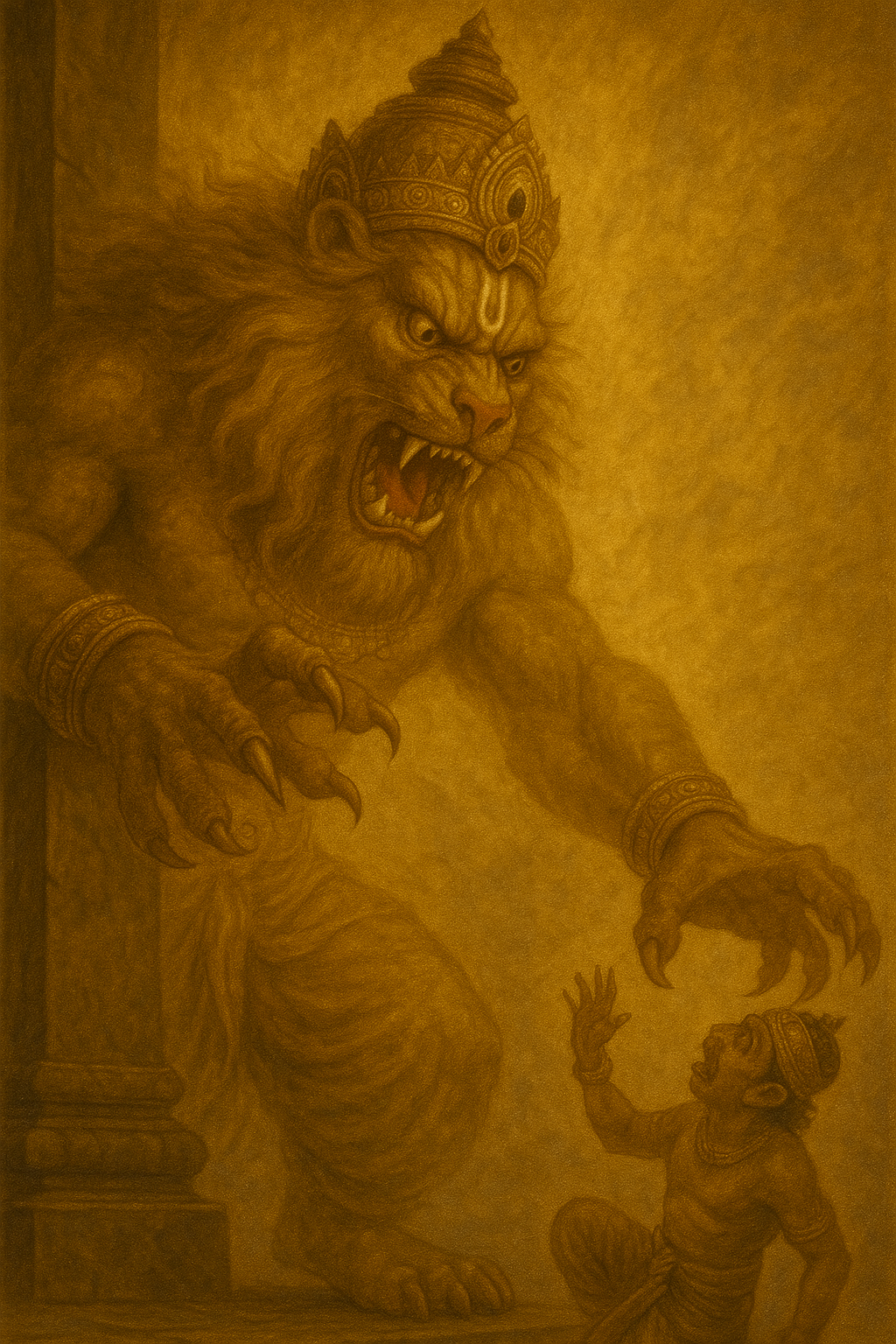
The Film That Opened the ‘Floodgates’ of Thoughts and Emotions
I watched Mahavatar Narasimha last night – and I wasn’t prepared for what came over me – the waves of emotion. The chills. The stark contrast between a demon’s fury and a beautiful child’s unwavering faith. But more than that, I was stupefied by the questions it stirred.
How could a ruler like Hiranyakashipu – who commanded the universe with a ruthless precision for millions of years (107 million years to be precise) – be brought down to his knees by a five-year-old child’s simple, unwavering faith? Why is it that in the same lineage, we find such stark contradictions – Prahlada, the most celebrated devotee of the Lord, a powerful demon father like Hiranyakashipu, an evil aunt like Holika, and a sister Simhika (Prahlada’s), the mother of Rahu – a notorious asura?
And then, how curious that his grandson Bali was again a Mahabhagavata blessed by Lord Vamana Deva Himself?
Clearly, something deeper is at play here.
Prahlada – A Pure Devotee Born Among Demons
Prahlada Maharaja was no ordinary child. He was born into a lineage soaked in pride, conquest, and rebellion against the Supreme Lord – yet this little boy emerged like a beautiful, soft lotus in a muddy pond, giving great joy to his mother Kayadhu. Even while in the womb, he heard the glories of The Supreme Lord Vishnu from Sri Narada Muni. He was born with no interest in ruling, fighting, or scheming. He was interested only in one thing – total surrender. And this surrender to the Absolute Truth manifestation, Lord Narayana, is what his father, Hiranyakashipu, raged at. ‘How could HIS own blood chant Lord Vishnu’s name? That Vishnu who was his sworn ‘enemy‘?!
And yet, that’s the bewildering nature of divine grace – it can bloom in the most unexpected soil. And Prahlada’s devotion was so pure that it moved even the ferocious Lord Narasimha to a state of compassion. He prayed not only for protection – but for his father’s liberation. And the Lord granted it.
Later, from this same lineage, emerged Bali Maharaja – another extraordinary soul whose surrender pleased the Supreme Lord so much that He Himself became Bali’s doorkeeper.
What a lineage! What a wonderful mystery!
The Puzzle of Lineage – Devotion, Demons, and Divine Paradox
This is the time to pause, review and reflect once again:
- Prahlada’s father: Hiranyakashipu – one of the most fearsome demons in all of cosmic history.
- Prahlada’s sister: Simhika – mother of Rahu, who causes eclipses and is feared across universes.
- His grandson: Bali Maharaja – so surrendered, Lord Vamana Deva took three steps, the third on his head, and made him king of Sutala with His Personal Divine Guardianship.
What does this teach us?
That demon and devotee are not roles assigned by family, looks, or status – but by consciousness. A royal birth cannot guarantee purity, just as a demonic womb cannot prevent devotion. It is one’s choices, surrender, and intent that determine whether we move toward the light – or away from it. In the Lord’s eyes, it is the bhāva (consciousness), not the varna (nature/action field categorization), that matters. That’s why the Lord is also known as Bhavagrahi Janardana.
Who Is the Real Demon?
We tend to picture demons as monstrous entities – with fangs, claws, and terrifying roars. Perhaps they were, once upon a time. In kaliyuga, we tend to find highly deceitful asuras who are externally, completely normal-looking. The real asura is often subtle. Today, he may wear a three-piece suit. He may quote verses from the scriptures. He may run corporations, or even countries.
A demon is not defined by form – but by intent.
When ego replaces devotion, when control replaces surrender, when the tiny living entity tries to think itself as elevated above God, and worse, present itself as God Himself – that is the true demonic mindset. Even a brilliant, charismatic leader like Hiranyakashipu – who had mastered yogic siddhis, boons and commanded fear – was nothing but dust in front of a child who simply trusted the Supreme Lord.
And grace…? It was given to the one who bowed in humility; not to the ‘powerful’
The Grand Irony – How Grace Bewilders even the Most Intelligent!
For all his control, high material intelligence, and meticulous planning for dominion over the universe, Hiranyakashipu couldn’t see what his own son could: That the Lord is everywhere, even in the pillar. The demon’s downfall wasn’t due to lack of power – but due to refusal to even acknowledge, leave alone surrender, that There IS the One who CAN be and is definitely and infinitely superior to Him . Herein lies the paradox that confuses modern minds:
- Grace is not earned. It is granted.
- It need not be logical by standards of material measurements
- It doesn’t come through CVs, IQ, or frameworks.
- It ‘comes’ when the ‘I’ goes.
This is why the most brilliant rebels – scientists, atheists, politicians, or even spiritual pretenders – struggle with the principle of bhakti. Because grace doesn’t follow their rules of control, grasp, lust for grabbing knowledge and owning it. And that’s the most bewildering beauty of it:
Because grace doesn’t follow logic. It doesn’t bend to your merit, intellect, or ambition. It chooses the humble over the clever, the surrendered over the strategic. It arrives not when we prove ourselves – but when we let go of trying to. To the ego, this feels unfair. To the soul, it feels like home – very liberating!!
The Cosmic Suspense – Why We Should Never Judge Too Soon
If Simhika could be Prahlada’s sister…
If Rahu could get a seat among the planets…
If Bali Maharaja could surpass even the devatas in devotion…
Then who are we to judge anyone by their cover? This entire creation is a divine drama – scripted with suspense, apparent paradox, and yet with complete synchronicity and perfect timing, even amidst its embedded entropy. Today’s demon may be tomorrow’s surrendered soul. Today’s sage may fall by pride tomorrow.
Only the Lord sees through everything in everyone, sitting in their hearts. And He reserves His grace for those who are ready – not for those who assume they are.
That Pillar? It Still Stands – And So Does He, inside it!
We may think the age of avatars has passed. I hear parents and children alike sigh in frustration – ‘as if God will come now; as if He is around in such a terrible world’. But Narasimha still leaps; He can; and He will, if He wants. The pillar is still there physically and is also a metaphor now.
He may rise inside your heart, like the beautiful Sun, erupting as inner clarity, fierce conviction, or unexpected courage, if you invoke His protection and guidance. Or He may rise outside – as life or world events that shake our arrogance, burn our illusions, or protect the innocent.
He is within us as Paramatma, quietly watching. And He is outside us as the Cosmic Guardian, preserving dharma across creation. He protects the planets, the sages, the surrendered; and even the ones who forget Him – until they push too far. Because when demonic tendencies overstep, when ego misuses gifts without gratitude, and when we use intelligence to harm instead of heal, then rest assured, He will appear:
Sometimes as illness.
Sometimes as failure.
Sometimes as a fierce moment of loss that breaks the pride.
Sometimes as a divine fury that defends the truth that we try to crush.
Yet He stands tall above it all!
And in that moment, we are forced to see – afterall, we may be carrying a little Hiranyakashipu within us.
But we can also carry the seed of Prahlada, if we have the grace of a spiritual master, like Narada Muni. And right in the middle of both options, seated patiently in the heart, is the Lord Himself – waiting to see what we choose.
The pillar is there.
The Lord stands inside it.
The question is: where do WE stand?
All Glories to Sri Narasimha Dev Bhagavan for reinstilling faith in the hearts so many people, by displaying a spark of His energy on the theater screens. All glories to Prahlada Maharaja for showing us what real devotion is. And all glories to Vishwa Guru Srila Prabhupada who made love of Lord Narasimha a household duty and a process.
 REAL FREEDOM!